
5:30 a.m. — headlights flicker on one by one in the car park of a Taiwanese mountain course.
At half past five in the morning, car parks at courses in Taoyuan, Linkou, Tamsui, Taichung, and Kaohsiung begin to light up. Four friends who have played together for years skip the small talk about course conditions and open with a single question: "So, how are we playing today?"
Someone floats Match Play. Someone else suggests Nassau. But nine times out of ten, the group circles back to the same answer: "Let's play Vegas."
In Taiwan, "Las Vegas" — as golfers call it — has become the defining recreational format for a four-ball. It is not an official competition format, and no governing body has ever written a universal rulebook for it. Yet it has been passed down between players for decades, evolving into something different at every club and with every group: a living, breathing set of local rules.
Unlike professional stroke play, which is purely about shooting the lowest total score, Vegas blends mathematics, psychological warfare, team coordination, and a healthy dose of social etiquette into something that feels distinctly like golf culture.
From American Club Culture to Taiwan's Fairways
Vegas did not originate in Las Vegas, nor was it designed by the USGA as a formal competition format.
It is generally believed to have emerged in the mid-to-late twentieth century at private American golf clubs, invented by members looking to add drama to their regular games. The name "Vegas" borrows the city's connotations of high risk, high reward, and sudden reversals of fortune — not an actual geographic origin.
The format made its way to Taiwan roughly between the late 1980s and the 1990s, carried back by Taiwanese businesspeople traveling frequently between the United States, Japan, and Southeast Asia. In the early days it circulated mainly among corporate directors, executives at foreign firms, and club members. Over time, through team outings, corporate invitational events, and word of mouth from coaches and caddies, it spread to the wider amateur golfing community.
Taiwan's Vegas Has Already Gone Local
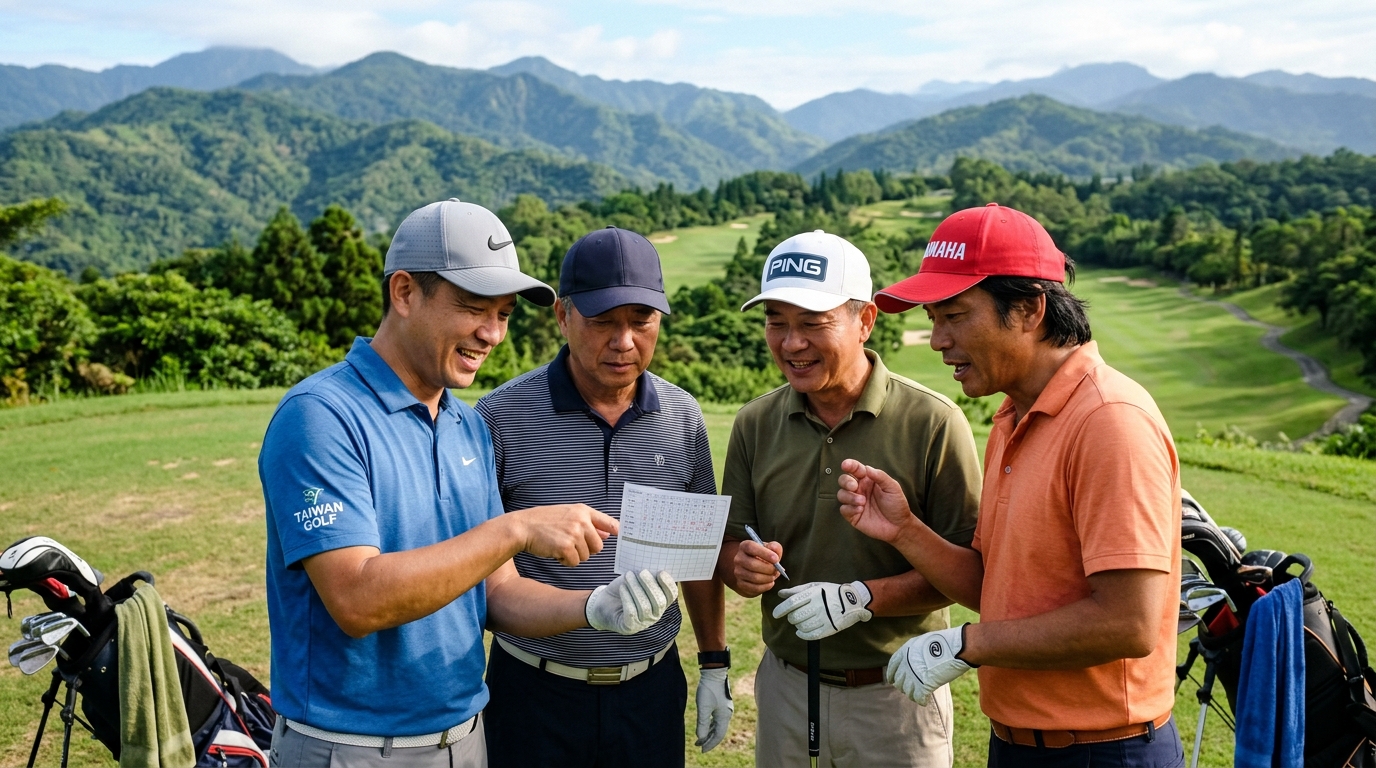
Sorting out the house rules before the first tee is itself a cherished part of Taiwanese golf culture.
While the underlying spirit is the same as the American original, Taiwanese golfers have long developed a version that fits local sensibilities. The most common setup remains two-versus-two: after each hole, each team combines its two players' scores into a two-digit number, with the lower score placed in the tens position. So if one player makes 4 and their partner makes 6, the team's hole score is 46. If the opposing team scores 55, the hole difference is 9 points (55 − 46 = 9).
What Happens When Someone Scores 10 or More?
The system runs into a practical problem when anyone posts a double-digit score on a single hole — two-digit combinations lose their meaning. Taiwanese golfers generally handle this in one of two ways:
- Method 1 (most common): Individual hole scores are capped at 9. Any score higher than 9 is recorded as 9, preventing three-digit combinations from appearing.
- Method 2: The cap is set at double par for each hole — 8 on a par-4, 10 on a par-5. This approach is more mathematically precise but also more complex; it tends to appear in groups with more consistent handicaps.
Because boundary rules like these vary from group to group, "sorting out the rules before teeing off" has itself become a cherished part of Taiwanese golf culture — as essential as warming up on the range.
What makes Taiwan's version genuinely distinct is that players almost never adopt the American rulebook wholesale. Instead, groups tailor the game to suit the players in the group. Common local variations include:
- Only a natural birdie (without stroke allowance) can trigger a Flip
- Beginner groups omit the Flip rule entirely to keep every hole competitive
- A per-hole point cap is set — for example, no more than 20 or 30 points can change hands on any single hole
- When there is a significant skill gap, handicap strokes are applied before Vegas scores are calculated
The Flip: Vegas's Most Heart-Stopping Moment

One birdie can flip the entire scoreboard in an instant.
The Flip is the dramatic centerpiece of Vegas. When a team makes a birdie on a hole, the opposing team's two-digit score for that hole is immediately reversed — the tens and units digits swap places.
This is precisely why a teammate's form matters so much in Vegas. When one player has already secured a safe par, their partner has the freedom to attack the flag aggressively — because a birdie doesn't just save one stroke, it flips the whole ledger.
As one amateur team captain from Taipei put it: "What we play isn't American Vegas. It's Taiwanese Vegas."
"It's Not Gambling — It's Adding Tension to the Game"
The casual observer might assume Vegas is synonymous with high-stakes gambling. The reality on Taiwan's courses is different. The vast majority of players treat it as light-hearted entertainment, with common stakes including:
- NT$10 per point
- NT$20 per point
- NT$50 per point
- Or simply keeping score, with the losers buying coffee or lunch afterward
Many regular groups even have an informal rule: "Fun only — winning and losing must never affect friendship."
A manager from Hsinchu's tech industry laughed as he explained: "The most anyone loses in our group is a bowl of beef noodle soup. What keeps us going is that you never know who's about to flip the board."
Why Do Business People Love Vegas So Much?

Vegas is a favorite among business owners, tech executives, doctors, and professionals — every hole is a fresh contest.
1. Fast-Paced Structure
Unlike stroke play, where only the 18-hole total matters, Vegas creates a new contest on every hole. Even after a terrible opening stretch, every hole is a fresh chance to claw back points.
2. Built-In Teamwork
Each player must execute their own shots, but strategy is shared. When one teammate has already found the green safely, the other can take risks and hunt for a birdie. A team that plays cautiously on every hole will rarely build a lead.
3. Stories That Outlast the Round
Over 18 holes, every hole produces a moment worth talking about. Who drained the long putt? Who flipped the board on the last hole? Whose out-of-bounds shot cost the team 20 points? These stories travel from the course to the restaurant and live on for years.
LINE Groups Have Changed Vegas Culture
Not long ago, golfers managed all of this with a paper scorecard and a pencil. Today, smartphones have transformed the experience. In Taiwan, most regular groups have a dedicated LINE group chat. One member logs the Vegas points hole by hole in real time; someone else posts a video of the clutch putt; another member maintains an annual leaderboard in a shared Google Sheet or Excel file, tracking each player's cumulative wins and losses across the whole season.
What Taiwan Golfers Actually Care About Most

After the round, the real highlight begins: scorecards spread across the table at Wěn Yíng Stir-Fry Restaurant (穩贏快炸小吃部), Taiwan Beer poured, and every hole replayed in vivid detail.
Look closely at golf culture in Taiwan and you start to see that the real reason Vegas has thrived here goes beyond the thrill of the game. It fits the way Taiwanese people naturally socialize around sport. The same four friends, every week, one round. The losers buy the drinks; the winners book the next tee time. Conversation flows from the fairway to the restaurant and on to work, family, investments, and life. Vegas is the vehicle. What it actually carries — what accumulates over years of weekly rounds — is relationships.
In Taiwan, golf has long since outgrown its identity as a purely competitive sport. It is a social culture. And Vegas has transformed it from an individual pursuit into a team sport layered with strategy, psychology, and camaraderie. For most amateur players, Vegas is not about the score — it is about 18 holes a week with a group of friends who know each other's swing as well as they know each other's families. It doesn't turn golf into a gambling game. It turns a round of golf into a story worth telling.
Manage Your Vegas Group with REN GOLF
Sign-ups, pairings, score tracking, and announcements — all in one app. So the organizer can finish the round and call it a day.
Explore the Team Management System →